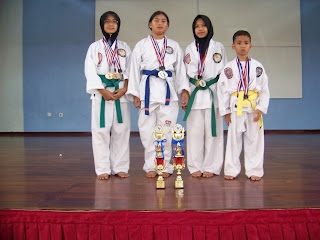
Auji Qistina: YATTAAAA !!!!

November 13, 2008


Hiro Nakamura of HEROES yelled:
"YATTAAAA!!!" which means " I Did It"
-he travelled through time

Who is this AUJI QISTINA?

She is one of my taekwon-do prodigee, my student at primary school.
She was awarded Best Student at SK Kg Baru Kerteh recently.
Refer to this post : -
http://hakimahzuhari.blogspot.com/2008/11/wan-auji-qistina-wan-roslan.html

Then I found out not only her, my other TKD students from the school were also nominated and the Best Boy Student also won by a taekwondoist.


Golden U12 Team - Ain, Auji & Rabihah
That little boy is Rabihah's brother who was Overall Boy Champion


Copied & Pasted from
*scream out loud*


anugerah yg dinobatkan
:
  • tokoh murid skkbkth 08
  • cemerlang ko-kurikulum
  • terbaik matapelajaran : sivik
  • terbaik matapelajaran : kemahiran hidup


kepimpinan :
  • pengawas sekolah : bendahari
  • badminton : ketua pasukan
  • bola jaring : ketua pasukan
  • sofbol : ketua pasukan
  • bola baling : ketua pasukan
  • olahraga : pemain
  • pasukan kawad kaki : komanden
  • rumah sukan : ketua rumah
  • puteri islam : pengerusi
  • taekwondo : ketua kelab
  • perkhemahan unit beruniform : penghuluwati
  • kelab tarian : pengerusi
  • kelab doktor muda : naib pengerusi

penglibatan dan pencapaian khas:-
  • jamboree pergerakan puteri islam : peringkat kebangsaan 07,
  • jamboree pergerakan puteri islam : johan aktiviti lasak
  • kejohanan taekwondo sekolah2 terengganu : peserta terbaik negeri 07,08
  • per.sofbol sekolah2 terengganu : johan peringkat daerah
  • per.sofbol sekolah2 terengganu : peringkat negeri
  • per.badminton sekolah2 terengganu 06,07,08 : johan pkg
  • per.badminton sekolah2 terengganu : naib johan daerah
  • per.badminton sekolah2 terengganu : peringkat negeri
  • mssd : olahraga 06
  • mssd : lontar peluru 07, 08
  • per.tarian sekolah2 terengganu 07 08 : johan daerah
  • per.tarian sekolah2 terengganu 07 08 : naib johan negeri
  • per.koir 07 08 : naib johan peringkat daerah
  • per.koir 07 08 : peringkat negeri
  • mencipta logo 5s petronas penapisan : johan
  • kawad kaki 06 07 : johan daerah
  • kawad kaki 06 07 : peringkat negeri
  • melukis poster anti dadah : tempat ke-3

"Aku Berjaya" ... But this time not only "Aku" but kami berjaya. It was first and foremost, her own effort plus prays from her parents and teachers. As one of those who teach her... "Aku Berjaya". I pray for her and her colleagues success.

----- Update at 1:40PM-13/11/08:
CONGRATULATION on your 5A's UPSR.


Read more...

KARNIVAL WAJA DIRI 2008

KARNIVAL Waja Diri dahulunya dikenali sebagai KARNIVAL SENI MEMPERTAHANKAN DIRI HARI KEBANGSAAN, diadakan setiap tahun sempena hari kebangsaan dan menjadi aktiviti tahunan anjuran Kementerian Belia Dan Sukan Malaysia.

Karnival ini mula diperkenalkan pada tahun 1996 yang mana GM Dato' Sabree Salleh menjadi Pengarah Teknikal Pertama yang menyelia aktiviti di peringkat kebangsaan ini. Boleh dikatakan beliaulah yang menemukan semua perguruan seni bela diri di negara ini bagi menjayakan program yang bertujuan mempromosi aktiviti-aktiviti sihat seni bela diri dan meraikan Hari Kebangsaan. Justeru semua bela diri beraliran silat, taekwon-do, wushu, karate, silambam dll. beridentitikan bangsa dan masyarakat majmuk disatukan melalui program sebegini. Setiap negeri melalui Jabatan Belia Dan Sukan masing-masing akan menyediakan kontinjen yang terdiri dari pelbagai seni bela diri.

Acara-acara dipertandingkan mengikut disiplin seni masing-masing dan melalui setiap badan seni bela diri kebangsaan. Ini bermakna, negeri yang mempunyai badan seni bela diri yang pelbagai mempunyai peluang pungutan pingat yang lebih baik. Sebagai contoh Selangor, Wilayah Persekutuan dan Pulau Pinang, boleh dikatakan negeri-negeri ini mempunyai semua jenis seni bela diri. Tidak seperti Terengganu yang terhad kerana ratio populasi bangsa Melayu adalah jauh lebih tinggi dari bangsa lain. Justeru seni bela diri seperti Silambam, Kalari Payat, Wushu dan Karate-Do tidak mendapat tempat kerana tidak wujud persatuan di peringkat negeri Terengganu. Seni seperti Silat Gayung, Silat Cekak dan Taekwon-Do lebih popular. TAEKWON-DO pula dipecahkan kepada dua perguruan melalui badan kebangsaan MTA (WTF) dan MITF. Kini masih juga dua dengan MTA (WTF) diketepikan akibat masalah dalaman dengan Pejabat Pesuruhjaya Sukan - acara ITFM dan MGTF kini dipertandingkan.

Karnival 1996 mencatat sejarah untuk PTNT (dahulunya dikenali sebagai PTT (ITF) apabila menjadi satu-satunya persatuan yang berjaya mewarnakan EMAS kepada JBS Terengganu. Lebih bangga buat diri saya lagi kerana menjadi individu berkenaan. Saya telah membantu melalui 1 Emas dalam Free Sparring dan 1 Perak dalam Individual Pattern.

Karnival seterusnya juga melihatkan penguasaan fighter dari Terengganu seperti Nasree Najmi, Nasriah Najmi, Mohd Badri, Ahmad Faiz, Jaysuman (kini ITFM), Siti Shaheila (kini ITFM) dan ramai lagi semasa remaja mereka yang berjaya membuahkan pingat untuk kontinjen JBS Terengganu.

Karnival 2008 - USM Pulau Pinang
27-30 November 2008

Kini syarat-syarat diperketatkan dengan pembabitan umur maksima 21-Tahun dan yang telah memenangi pingat di peringkat kebangsaan tidak dibenarkan sama sekali. Ini bermakna, pasukan Taekwon-Do MGTF Terengganu tidak boleh menurunkan fighters seperti:-

Nasirewan (20 Tahun) - Pemenang Emas & Perak MGTF 2008 & Gangsa Sukma 2008
Putri Adriana (16 Tahun) - Pemenang Emas MGTF 2008
Aizuddin (20 Tahun) - Pemenang Gangsa MGTF 2008

Bagaimana pun pasukan ini masih tidak ketandusan remaja yang berkelayakan dan mampu memberi saingan sengit. Peserta-peserta yang berjaya semasa Kejohanan Taekwon-Do Tahunan Terengganu dari 2006 hingga tahun ini disaran menyertai saringan yang dikendali oleh En.Nasirewan.

Persediaan pelatih-pelatih diadakan di dua buah pusat latihan iaitu di Pusat Latihan Kuala Terengganu di bawah kendalian Nasirewan dan di Pusat Latihan Kemaman di bawah saya sendiri. Persediaan juga dibantu oleh jurulatih seperti En.Rahman dan En.Aizuddin.

KT Centralised Training:-


Kemaman Training:-
(KEMTA Do-Jang)


Saringan terakhir pada 21 November ini........

Read more...

Bahasa Melayu Bahasa Malaysia

November 05, 2008

Encyclopedia > Malay language
Malay
Bahasa Malaysia / Bahasa Melayu, بهاس ملايو
Spoken in: Brunei, Indonesia, Malaysia, Singapore, southern Thailand, southern Philippines, Australia
Total speakers: 20–30 million (first speaker), almost 400 million (second speaker including Indonesians)
Ranking: 54 (does not include Indonesian)
Language family: Austronesian
Malayo-Polynesian (MP)
Nuclear MP
Sunda-Sulawesi
Malayic
Malayan
Local Malay
Malay
Writing system: Rumi (Latin alphabet) (official in Malaysia, Singapore and Indonesia; co-official in Brunei) and Jawi (Arabic script) (co-official in Brunei). Historically written in Pallava, Kawi and Rencong
Official status
Official language in: Brunei, Malaysia, Singapore, Indonesia, East Timor (working language)
Regulated by: Majlis Bahasa Brunei Darussalam - Indonesia - Malaysia (Brunei Darussalam - Indonesia - Malaysia Language Council), Dewan Bahasa dan Pustaka (Institute of Language and Literature) Pusat Bahasa, Indonesia
Language codes
ISO 639-1: ms
ISO 639-2: may (B) msa (T)
ISO 639-3: variously:
msa – Malay (generic)
mly – Malay (specific)
btj – Bacanese Malay
bve – Berau Malay
bvu – Bukit Malay
coa – Cocos Islands Malay
jax – Jambi Malay
meo – Kedah Malay
mqg – Kota Bangun Kutai Malay
xmm – Manado Malay
max – North Moluccan Malay
mfa – Pattani Malay
msi – Sabah Malay
vkt – Tenggarong Kutai Malay

The Malay language (ISO 639-1 code: MS)[1][2] (Malay: Bahasa Indonesia (Indonesia) | Bahasa Malaysia (Malaysia) | Bahasa Melayu (Singapore and Brunei); Jawi script: بهاس ملايو) is an Austronesian language spoken by the Malay people and people of other races who reside in the Malay Peninsula, southern Thailand, the Philippines, Singapore, central eastern Sumatra, the Riau islands and parts of the coast of Borneo.[3]. This is a list of languages, ordered by the number of native-language speakers, with some data for second-language use. ... A language family is a group of languages related by descent from a common proto-language. ... The Austronesian languages are a language family widely dispersed throughout the islands of Southeast Asia and the Pacific, with a few members spoken on continental Asia. ... The Nuclear Malayo-Polynesian languages are a branch of the Austronesian family that are thought to have dispersed from a possible homeland in Sulawesi. ... The Sunda-Sulawesi languages (or Inner Hesperonesian or Inner Western Malayo-Polynesian languages) are a branch of the Austronesian family which include the languages of Sulawesi and the Greater Sunda Islands, as well as a few outliers such as Charmorro and Palauan, as outlined in Wouk and Ross (2002). ... The Malay language, also known locally as Bahasa Melayu or Bahasa Malaysia, is an Austronesian language spoken by the Malay people who reside in the Malay Peninsula, southern Thailand, the Philippines, Singapore, central eastern Sumatra, the Riau islands, and parts of the coast of Borneo. ... The Malay language (Malay: Bahasa Melayu; Jawi script: بهاس ملايو), is an Austronesian language spoken by the Malay people who reside in the Malay Peninsula, southern Thailand, the Philippines, Singapore, central eastern Sumatra, the Riau islands, parts of the coast of Borneo and even in the Netherlands[1]. It is an official... Local Malay languages are a group of closely related languages that are the results of Malay outposts across Malaysia and Indonesia. ... Writing systems of the world today. ... It has been suggested that this article or section be merged with Yawi. ... It has been suggested that this article or section be merged with Tamil script. ... Dewan Bahasa dan Pustaka or DBP is a government body that responsible to coordinate the use malay language in Malaysia and Brunei. ... The Pusat Bahasa (Indonesian for Language Center) is the institution responsible for designing and regulating the growth of the Indonesian language in Indonesia. ... ISO 639-1 is the first part of the ISO 639 international-standard language-code family. ... ISO 639-2 is the second part of the ISO 639 standard, which lists codes for the representation of the names of languages. ... ISO 639-3 is an international standard for language codes. ... Jambi Malay is a variant of the Malay language spoken in Jambi (province). ... Manado Malay is a language spoken in Manado and the surrounding area. ... The Unicode Standard, Version 5. ... ISO 639-1 is the first part of the ISO 639 international-standard language-code family. ... The Austronesian languages are a language family widely dispersed throughout the islands of Southeast Asia and the Pacific, with a few members spoken on continental Asia. ... The Malay Peninsula (Malay: Semenanjung Tanah Melayu) is a major peninsula located in Southeast Asia. ... Borneo is the third largest island in the world and is located at the centre of Maritime Southeast Asia. ...


Malay is an official language of Malaysia, Brunei, Singapore, Indonesia, and East Timor. In Indonesia and East Timor, the language is formally referred to as Bahasa Indonesia, which literally translates as "Indonesian language." It is also called Bahasa Kebangsaan (National Language) and Bahasa Persatuan/Pemersatu (Unifying Language) in Indonesia. In Malaysia, the language was once officially known as Bahasa Malaysia, ("Malaysian language".)
An official language is a language that is given a special legal status in the countries, states, and other territories. ... Indonesian or Bahasa Indonesia, based on the Riau version of Malay language, was declared the official language with the declaration of Indonesias independence in 1945, following the 1928 unifying language declaration in the Indonesian Youth Pledge. ...

....................More at http://www.nationmaster.com/encyclopedia/Malay-language and also Wikipedia at http://en.wikipedia.org/wiki/Malay_language

My Comment in my native Malay dialect:-

1) Super yer jer, due-due makne same, hok tu ler jer.
2) Oghang politik duk guner pekataang nok wi sedak hati pihok-pihok bekenaang. Tapi mende gini peting jugok sebak kene mengene dengang pepaduang masharaka' bebilang kaung.
3) Zainuddin Maidin duk saloh ke Anwar Ibrahim hok tukor dari Bahasa Malaysia ke Bahasa Melayu, walhal dier pong guner sebak nok kauk undi bukang Melayu, nok wat sedak hati.
4) Sebelum Malaysia namer negare kiter ni Persekutuan Tanah Melayu, doh nok kira guaner? Dok ke yang tu hok asal kita.
5) Ader universiti kat negare orang putih rasanya ader fakulti bahasa Melayu, yang duk ngaji bahasa asal tanoh hok kita duduk lening, doh mintok la tukor sekali nama tu. Guaner DBP dok berapa cakner?

Read more...

"Old Man" Taekwondoists

November 03, 2008

Taekwon-Do contains many techniques to be learnt and hyungs or pattern movements to be memorised. Many of young students who hold senior rank color belts when they take a break from attending training for sometime (normally during their school/college holiday), will simply forget their patterns and even required kicking techniques to be performed for their respective upgrading test. They simply do not understand why they need to pursue training even though not in the presence of instructor.

I have encountered old taekwondoist friends who come for my training when they find out that I am still active in this arena and got several schools which they can attend, they decide to resume their taekwon-do lesson, after all my Dan/Degree now is higher than them. They have paused training for a quite long time. After college they found job and get married and have children and surely time consuming they have no training at all in taekwon-do, but they were during their school and college days among the best and hardworking taekwon-do practitioners, even much senior than I am.

Surprisingly, they can still remember all the patterns. Yes for a while they seems to forget, but when I showed them a little movement, they recaptured the memory. In free-sparring techniques and self-defense it is much easier for them to rejuvenate. It is so different with nowadays young practitioners.

WHY? ... When a taekwondoist trains patterns or techniques continously and repeatedly he will master them easily, although not perfect, but able to perform them well with confidence. We called it Muscle Memory.

In free-sparring, muscle memory plays vital role. When a taekwondoist trains certain technique repeatedly he will be able to perform for example a counter-attack with speed which is due to his reflect ability.

I have to admit some of my old friends and students like Rahman, Shahabuden and Tun are part of this kind of practice and tradition. They gain reflect and memory throughout their past experience. They were sharp before but blunt during halt, alas - their body still be able remember the movements and continuing taekwon-do lessons is not a burden and they will love it as before. They only struggle with stamina. Hence trainings with accessories in taekwon-do gym will improve them. Another problem they are facing is "fatigue" due to daily professional job (this will be discussed later).

This is an extract from Wiki:-
When an active person repeatedly trains movement, often of the same activity, in an effort to stimulate the mind’s adaptation process, the outcome is to induce physiological changes which attain increased levels of accuracy through repetition. Even though the process is really brain-muscle memory or motor memory, the colloquial expression "muscle memory" is commonly used.

Individuals rely upon the mind’s ability to assimilate a given activity and adapt to the training. As the brain and muscle adapts to training, the subsequent changes are a form or representation of its muscle memory.

There are two types of motor skills involved in muscle memory: fine and gross. Fine motor skills are very minute and small skills we perform with our hands such as brushing teeth, combing hair, using a pencil or pen to write, touch typing or even playing video games. Gross motor skills are those actions that require large body parts and large body movements as in the throwing sports such as bowling, American football, and baseball, sports such as rowing, basketball, golf, judo, and tennis, and activities such as driving a car (especially one with a manual transmission), playing a musical instrument, and marksmanship.

Muscle memory is fashioned over time through repetition of a given suite of motor skills and the ability through brain activity to inculcate and instill it such that they become automatic. Activities such as brushing the teeth, combing the hair, or even driving a vehicle are not as easy as they look to the beginner. ..........


Above all of these, it is
willingness to pursue trainings and maintain at reasonable level and contribution to society is much more important. Something hard to achieve by many working class.

-- A BIG "L" TO NOWADAYS COLLEGE TAEKWON-DO STUDENTS, SORRY TO SAY --

Read more...
Related Posts with Thumbnails

About This Blog

  © Blogger template Brownium by Ourblogtemplates.com 2009

Back to TOP